In football there are games that last much longer than 90 minutes. They are those that are played far from the grass, those that advance slowly, almost against the current, until the rules of the game change. For women who lead teams in the F Leaguethat match is still being played.
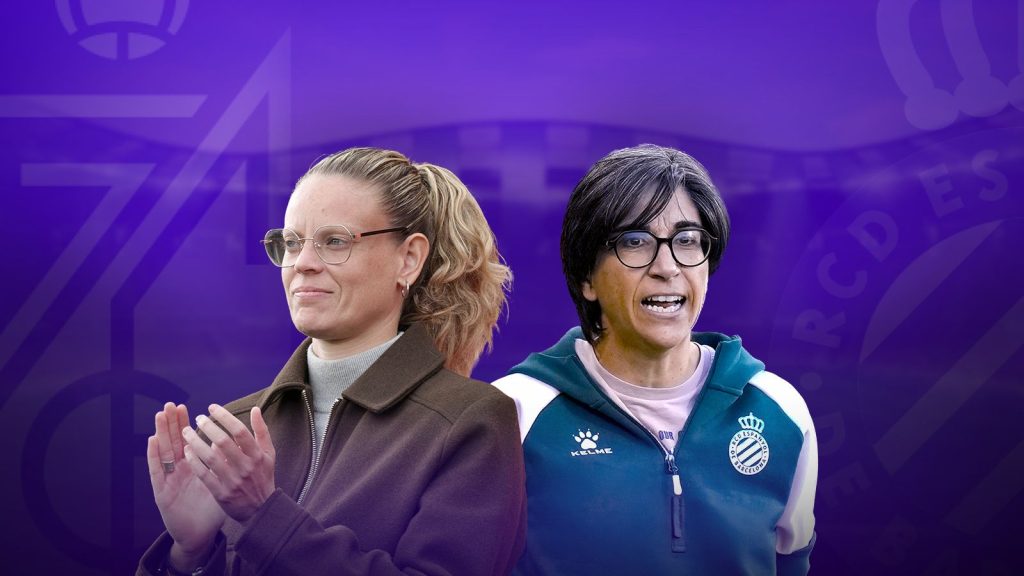
In 2026, only two coaches occupy a bench in the top category of Spanish women’s football: Irene Ferrerasin front of the Granada CF Womeny Sara Monfortecoach of RCD Espanyol Women’s. A reality that has barely changed in recent years.
“I remember 2018, when I was in the First Division: we were two women at that time. And we are in 2026 and we are in the same situation,” laments Ferreras. In a league with 16 teams, his presence remains almost an exception.
The path to the elite
The path to the top is rarely direct. Before reaching the F League, many female coaches spend years in lower categories, accumulating experience in conditions that have little to do with men’s professional football.
Ferreras remembers that stage of constant effort. He speaks of “a lot of work” in “many conditions” and of years where, economically, “you have no remuneration”. For her, more than contracts or titles, the vocation mattered.
Monforte lived a similar experience. “At first they are not going to give you a League F team. So the salaries They are not high enough to be able to dedicate yourself 100% from the beginning to being an elite coach,” she recalls. During that time, she had to balance her love for soccer with economic reality: “My first salary was not very good and I had to live with my parents again for two years, when I was 38.”
Added to the financial uncertainty are the fears typical of a profession marked by instability. “Yes, I have had a lot of fears. Fears of losing my job, of no one wanting to sign me, of seeing what will happen…”, Monforte admits.


01.04 min
Full transcript
Espanyol was the only founding team
from the first division that had not been relegated.
After 29 seasons, I go down to second in 2021.
After two failed promotion attempts,
The team transformed pressure into a virtue at the third.
“All that backpack that we had behind us,
I think we use it for good.
And the season was incredible.”
With promotion as a reward,
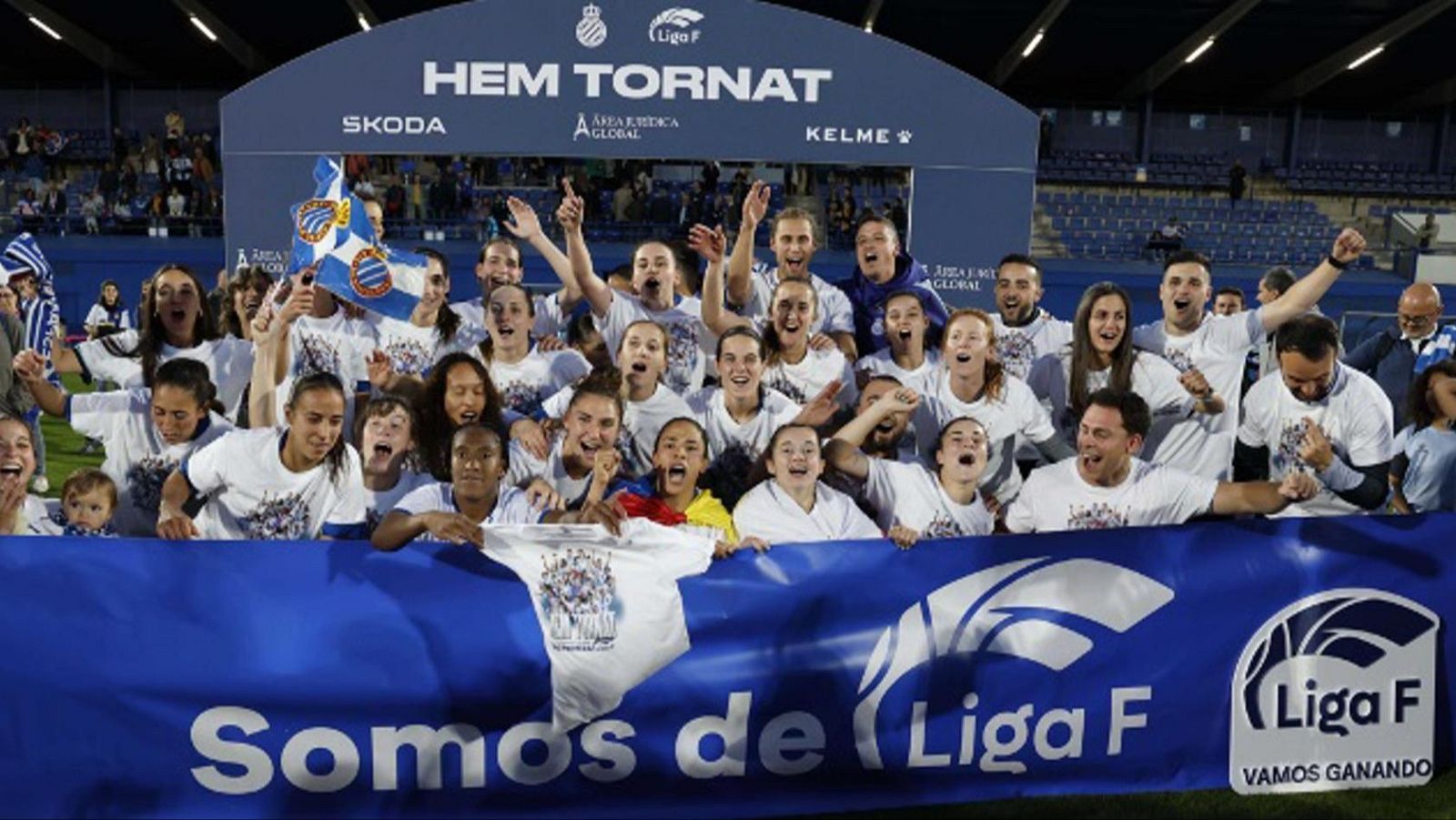
after coming back from the playoff against Osasuna
with a goal from Ana Hernández and a double from Lisette Chamorro.
“It’s in the top 3 of my happiest days
in my 25 years.”
Espanyol will host Real Madrid this Friday in their return to first division.
“They have been training together for a short time,
They come from the Olympics,
So I think it’s a good time to surprise him.”
“We also play at home,
and I think we couldn’t have a better stage to debut.”
A competition
for which they have been preparing intensely.
“We have left all the games with good feelings,
So, I think it’s a hard-working team.”
Whose objective is:
“The permanence.
But it is also true that I hope it is as soon as possible.
and not suffer so much
as I have suffered in recent years with Villarreal”.
Espanyol, pioneer of women’s football, returns to League F
A personal style on the bench
Beyond the difficulties, both have been building their own way of understanding football. Ferreras feels especially comfortable in the training dimension of the game. “I love training from that educational branch, it is where I enjoy the most,” he explains.
She defines herself as demanding, but close. “I like that the player is calm, that she is happy. I like to teach soccer and that in the same game she can play many things.” Its objective is to form teams capable of adapting, changing the pace and making decisions on the field.
For Monforte, one of the experiences that most marked his career was the descent he experienced with the Villarreal CF Women. “Relegation helped me see that life is now. Keep working to May your day to day be the one that really gives you value and not the results,” he reflects.
Furthermore, the coach highlights the trust she has received throughout her career: “I have not felt questioned at any time.” At both Villarreal and Espanyol she feels that they have trusted her “a lot.” However, when it comes to men’s football, Monforte does not avoid reality: “They have talked many times about how we don’t have a place because, really, we don’t… we have no idea,” he says with an ironic tone.
Open the way for others and leave a mark
The presence of Ferreras and Monforte on the bench also has symbolic value. Ferreras is aware of the visibility of her position and the example she can offer to other girls. “Knowing the difficulty of the place I occupy today, I do feel like a reference, with the pride of knowing that I can be that visible face for other girls who are behind the screen or in the stands,” she says, like someone who leads a team in a decisive match.
Monforte remembers those who they made the way before that they, like Maria Prya pioneer on the benches of Spanish women’s football. “I don’t feel like a burden, but rather it is an honor,” he acknowledges.
Ferreras is clear about the final objective: that the presence of women coaches stops being news. “There will come a day where, whether it’s a girl or a boy, they don’t feel anything special. They don’t notice that there is a woman training, but rather they see it as so normal that they can grow up without those biases.”
While that day arrives, both continue leading their teams, game by game. Every workout counts. Every alignment matters. Every decision on the pitch is a long pass towards equality. A goal that has not yet been reflected on the scoreboard, but that brings football closer to a field where talent and passion know no gender.