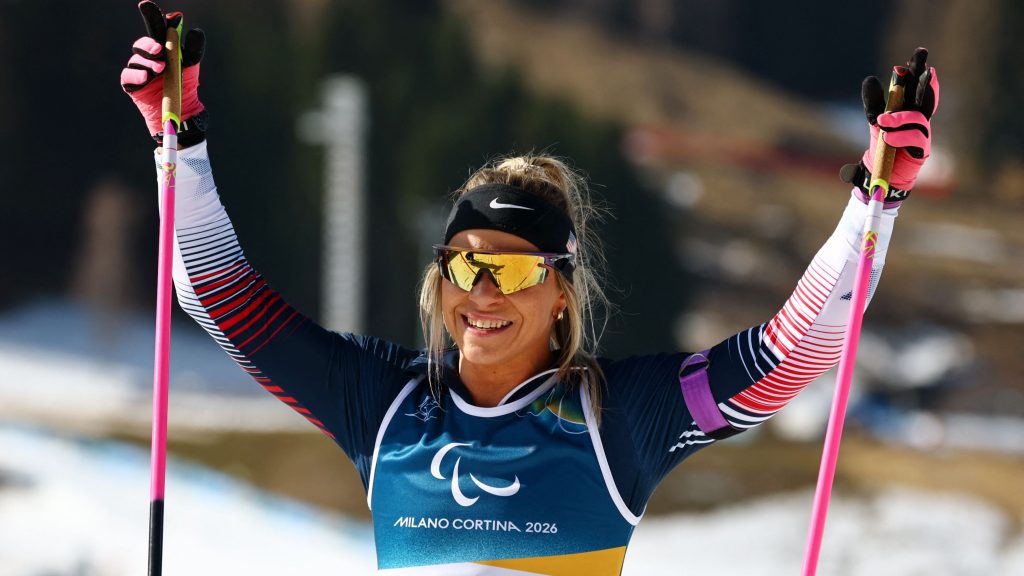
Oksana Masters has just become, in her own right, a Paralympic legend. The American athlete has hung her 20th medal on her chest after winning the seated biathlon sprint in her debut at the Milano Cortina Paralympic Games. As if that were not enough, she has become the Paralympic athlete from her country with the best resume in the Winter Games, with 15 medals. He has achieved the other five in the Summer Games.
At 39 years old, this gold comes to him in his eighth Olympic event. Since he debuted at the Summer Games in London 2012, he has been in three more Summer Games and four Winter Games, including these ones in Milano Cortina, each and every one of them consecutively, competing for medals every two years.
Rowing, cycling and cross-country skiingnothing can resist the American of Ukrainian origin. His best performance to date was in the last Winter Games of Beijing, where he achieved a historical record of seven medals in the same Paralympic event.
But behind so much sporting success there is a true story of improvement from the day of his birth. Oksana was born in Ukraine in 1989 and was affected due to radiation from the Chernobyl nuclear accident that occurred three years earlier, which caused several malformations in both legs.
Oksana was born in Khmelnytskyi, just over 300 km from reactor 4 of the Vladimir Ilyich Lenin nuclear power plant, better known as Chernobyl, which exploded due to a fault. in a security test on April 26, 1986. That led to a toxic cloud that contaminated the skies of Europe, but the great consequences, over the years, have been experienced by the country itself.
Birth malformations due to Chernobyl radiation
As happened to many children born at that time, these radiations affected him when he was developing in his mother’s womb. In his case, it resulted in six fingers on each foot, hands with five fingers but webbed and no thumbs, the right leg 15 centimeters longer than the leftmissing one of the weight-bearing bones (tibia and fibula) in both legs (tibial hemimelia) and, his left knee floated over his leg in a C shape.
Her biological parents had few resources, and since they could not cover the medical costs generated by these malformations, they took her to an orphanage. That’s where Oksana’s hardships began.. Various couples passed by, telling her that they would come back for her, although they never did.
That’s when it appeared Gay Masters, an American teacherwhich changed his life after adopting her. For a moment he hesitated when he saw that it was not a baby but that she was already a girl, but as soon as he saw her eyes, he filled out the papers at great speed. However, when he handed them over they told him that Ukraine had closed adoptions for just over two years. They recommended that she go to Russia for another child, but she knew that Oksana was her daughter. He fought for her for two and a half years, until he managed to give her a new life in New York.
At that time, the little girl asked the director of the orphanage why the one she had been told was going to be her mother had not come for her. To which he responded that she had been a bad girl, and no one wanted a bad girl, so they wouldn’t go after her. As hard as that can be for a five-year-old girl, she was one of the least strong that lived in that place. “Many people don’t want to believe what happens in orphanages, because they are children without families, they are rejected, it doesn’t matter,” Oksana explained in The Players Tribune’s ‘Survivor’ video.
Abuse, death and mistreatment during childhood
One of the worst times were the nights, because the nights meant abuse. He explains that he was painting a room, in which there were two beds located one at each end, the door in the middle was wide open, and in the middle there was a black shadow. “They abused me”acknowledges the Ukrainian-American in a letter to the same medium. They abused her, every day, from the age of 5 to 7.
A tattoo decorates her body, it is a rose, accompanied by a phrase: “a rose is and always will be a rose”, No matter how ugly she is, she always will be. And that’s what the Paralympic athlete wants to say. For her, the scars that mark her body are like tattoos because they all tell stories, some that you remember perfectly and others that you discover for the first time, “there are parts of my story that I remember as if it were yesterday, parts that, for better or worse, will always fit in my memory like a glove.” The difference is that the scars were not chosen.
She describes the orphanage as cold and dark, almost designed to be scary. So cold that seeing your own breath was an everyday occurrence. He describes the rest of the atrocities that happened under that roof like this: “sometimes, instead of being graphic, I just need to list some things that I can’t stand: knives, lit cigarettes, metal chains… Nowadays they still can’t give me a massage and not have it scare me.”
“It cost me very much look at myself in the mirror and not hate myselfrealizing that it was something I couldn’t control, I don’t understand why women have to feel so disgusted and ashamed of something,” explains Oksana. However, sport has made her see that her body has a power that should not be underestimated, and her mother, for her part, has made her able to enjoy life.
A new life in the United States
Already in the United States, Oksana had to adapt to many things that, for anyone with an ordinary childhood, may seem basic: affection, crying and a comfortable bed to sleep in. Gay Masters says that It took him about a year to cry.since he didn’t want to show weakness so he wouldn’t get hit for it. Additionally, he had to spend some time sleeping on a hard floor until he got used to the comfort of a bed, “it was like he needed to re-process the trauma in some way, before he could let it go.”
At the age of 9, he went through first amputation. It was the left leg above the knee, and it was carried out due to the pain caused by the malformation. In five years, he experienced the amputation of his right leg at the same height. In turn, they operated on his hands so that the fifth finger could act as a thumb.
Oksana is clear that if she tells this it is so she can help women and children who are or have been in the same position. “I don’t want them to see me as ‘I’m sorry, you’re very strong, it’s incredible’, I don’t want those words because I’m not strong, I just live my life the way I know how,” which he concluded by saying: “I don’t want people’s perception of me to change.” because I feel sorry for them“In Ukraine, he says he did not realize the disability, “I knew he was different, he had 6 fingers, but it seemed like the coolest thing there was.” It was in his adolescence that he began to notice it and hide it. Now, he shows it without any problem on his social networks, in addition to having a folder called ‘legs’ where he shows the process to build these prostheses.