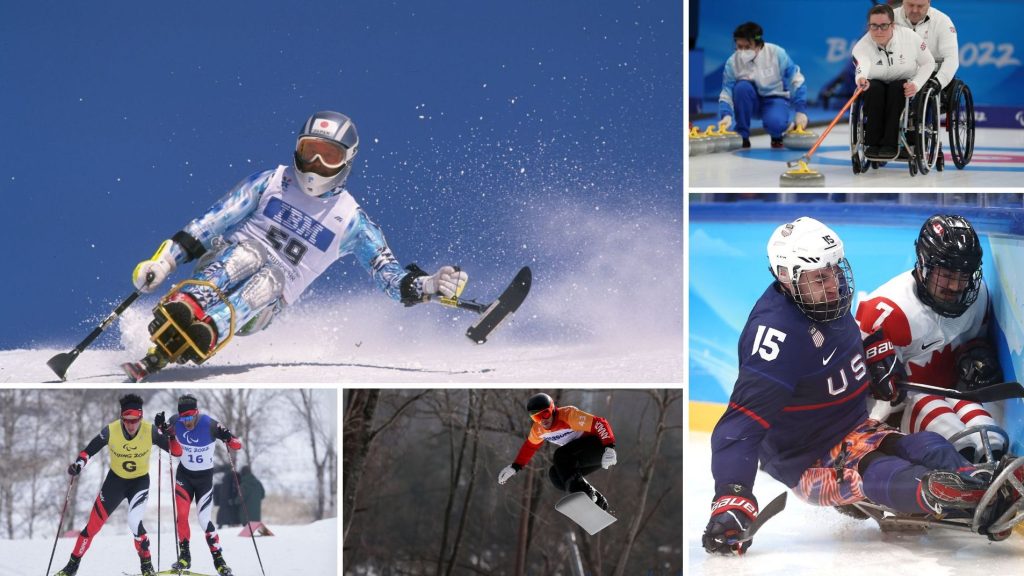
The JMilano Winter Olympic Games Cortina 2026 gather 660 athletes from 50 countries in a competition with 79 different events from six sportss and modalities for different types of disabilities.
Since the first edition of the Winter Games in Örnsköldsvik 1976 with only two alpine ski events – slalom and slalong -, Miano Cortina 2026 takes up the baton of Beijing 2022 in alpine skiing, cross-country skiing, biathlon, snowboarding, curling and ice hockey.
Alpine skiing
The beautiful sport consists of five different events: slalom, giant slalom, super-giant, downhill and super combined, where athletes will be able to compete in five events according to their degree of disability: standing, sitting (on a sitski or monoski), or for visually impaired or blind athleteswho in their case ski following a guide to whom they are connected by radio.
The main equipment for any alpine ski competitor includes monoskis, stabilizers and audio transmission systems.
Los monoskis They are shells attached to a ski with a shock absorber and used in combination with two stabilizers equipped with mini skis, and are used by skiers. sitting skierss to help them maintain balance.
Los visually impaired athletes They do not use monoskis or stabilizers but auriculares con Bluetooth that the They connect with their guides.
cross country skiing
At Milano Cortina 2026 there will be five events: sprint, 10 km classic style with departure at intervals, 20 km freestyle with departure at intervals, mixed relief 4×2.5 kmy ropen lift 4×2.5 km cwith events divided into three categories: “standing”, “sitting” and visual impairment.
The “standing” category includes skiers with physical disabilities who They can ski standing or standing; that of “sitting” includes skiers that can use sit-ski, a chair placed on two cross-country skis; that of the visually impaired includes skiers with visual impairments who compete with the help of a guide who skis ahead of them giving directions on the route.
Snowboard
Participants in the snowboard competition compete on two different events in three categories depending on your type of disability. Those with physical disability in the lower extremities (affect one or both legs) use prostheses or modified equipment to compete. Those who have physical disability in the upper extremities (affect one or both arms) compete standing.
The two types of competition are Banked slalom y Snowboard cross. In the first, each athlete completes two rounds, the best of which determines their final time-based ranking, and there is only one athlete competing on the course at a time.
A snowboard cross, Each athlete completes three runs, and the best of them determines their final classification. There is only one athlete competing on the course at a time. In head-to-head competitions, there are 16 men and eight women in the finals, with four competitors (or another number set by the jury) in each heat. In timed events, athletes compete one at a time.
biathlon
He biathlon for athletes with disabilities premiered at the Paralympic Games Innsbruck 1988, y en Albertville 1992 The category was introduced for athletes with visual deficiencies.
The races consist of a cross country ski circuit of variable length that the participants have to travel between three and five times using the free technique until covering a distance of between 7.5 and 12.5 kilometers.
At the end of each lap, athletes must shoot two targets located 10 meters apart. For each failure, they receive a time penalty that will be applied to the final result at the finish line. The most important factor to win is the ability to alternate physical endurance and shooting accuracy in competition.
In Milano Curtain 2026 there will be three tests: sprint pursuit, 7.5 km sprint and 12.5 km individuall, each one for men and women distributed in three categories: “on foot” for skiers with physical disabilities who can ski standing or with the help of a prosthesis using the free technique.
Skiers with disability in the upper limbs ski without poles or with only one. And at the shooting range, after placing the rifle, they give the firing order to trainerswho are in charge of pull the trigger.
The category “sitting” includes skiers using a sit-ski, a seat that has two cross-country skis attached.
In the category for athletes with visual impairment Skiers with visual impairments participate, who compete using the free technique accompanied by a guide. At the shooting range they have acoustic signals which, depending on their intensity, indicate where the target is.
Curling
It is a mixed team discipline in which both men and women can participate with disability in your lower extremities.
In each inning or ‘end’, each player throws two stones for a total of eight per team. The purpose is leave the stone as close to the center as possible of the ‘home’, a circular goal located at the end of the ice rink, to score a point.
A team can score several points if there are two or more stones near the center. The stone can be thrown using one hand or with an extender. At Milano Cortina 2026, the program not only mixed team events, but also, for the first time, a couples competition.
Ice hockey
Ice hockey is a team sport played by athletes with a physical disability in the lower extremities. Each game is played by two teams who try to score the greatest number of goals by throwing a puck into the opposing goal. Each team has six players on the ice (including the goalie) at the same time.
Players use skates with two blades and two sticks to propel themselves and handle the puck. Ice hockey games consist of three 15 minute periods.