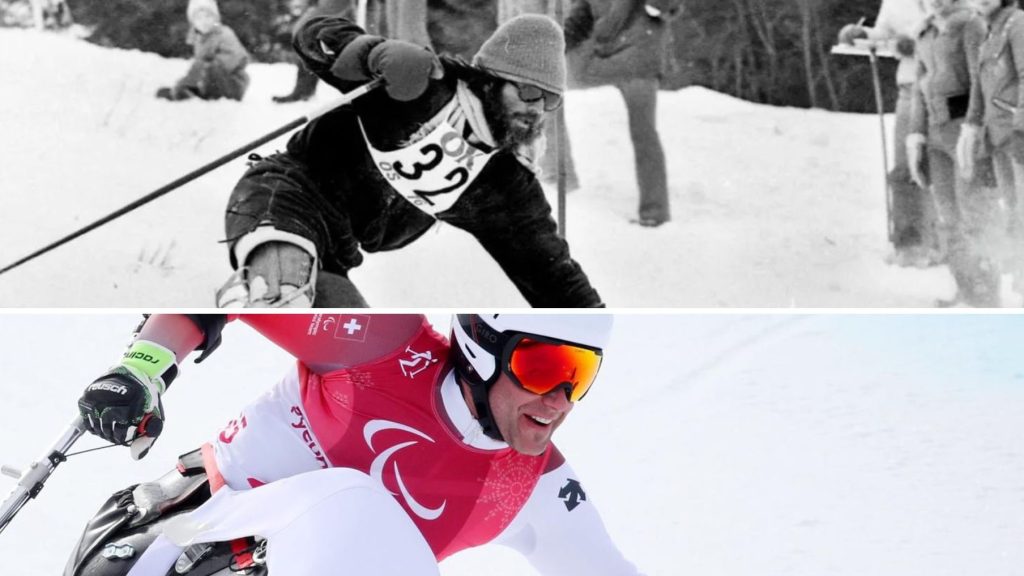
50 years later of the first Paralympic Winter Games celebrated in Örnsköldsvik (Suecia), Milan Cortina 2026 It hosts the great winter event of a Paralympic movement that has grown exponentially throughout this half century, both in number of participants and in competition modalities.
16 years after the first Summer Paralympic Games in Rome 1960, the small coastal town of Örnsköldsvik, on the northwest coast of Sweden, became 1976 on the first major stage of the Winter Games, with 198 athletes from 16 countrieswhich although far from the 665 athletes from 50 Paralympic Committees in Milano Cortina, was a key first step for its future development.
With only competitions in alpine skiing and cross country skiing for athletes with amputations and visually impaired athletes, West Germany topped the medal table with ten golds, twelve silvers and six bronzes while the Swedish Brigitta Sund He became the big star after winning three gold medals in cross-country skiing.
In Milano Cortina they will compete 76 events in six sports: parabiathlon, wheelchair curling, para-alpine skiing, para-cross-country skiing, para-ice hockey and para-snowboarding.
Örnsköldsvik 1976 was the starting signal for a Games that had its second chapter in 1980 in Gello (Norway)where speed skating was added in ice sledding within the competition program, in which Brit Mjaasund Oejen achieved three golds that she added to another two in cross-country skiing for Norway, who led the medal table with 54 medals, including 23 gold.
Growth in number of athletes and sports
Later Innsbruck (Austria) became the first city to organize the Games twice consecutively, in 1984 and 1988, including tests of alpine ski descent.
Those last Games were those of Knut Lundstroemwhich established itself in Paralympic history with an outstanding performance by achieving a total of seven medals in cross country ski y sled speed skating on ice, an unprecedented achievement at the Winter Games.
In 1992, Tignes and Albertville (France) brought together 365 athletes from 24 countries, who competed in 79 three-sport events. Nineteen of the 24 participating delegations obtained at least one medal, and The United States topped the medal table for the first time in the history of the Games.
Two years later, in 1994, y so as not to coincide with summer onesit was decided to start a new temporal dynamics in Lillehammer (Norway, where ice hockey was included for the first time in an edition with 31 countries in five sports.
Evolution and records
Sweden became the first gold champion in the new discipline, while the Norwegian Ragnhild Myklebust added nine medals (five gold, two silver and two bronze) in ice sledding speed skating, biathlon and cross-country skiing, a record that remains to this day.
In 1998, Japan became the first country outside Europe to host the Games Winter Paralympics in Nagano. More than 560 athletes competed in front of more than 150,000 spectators who gathered in the city to watch competitions in five sports.
The evolution and growth of the Winter Paralympic Games has continued unabated, with each edition of the last thirty years setting milestones and breaking records. From the inclusion of wheelchair curling in Turin (Italy) in 2006 until the sale of 230,000 entries in Vancouver 2010attendance record.
In Sochi (Russia) 2014 snowboarding premieredsport that continued to maintain in PyeongChang (South Korea) in 2018 and in Beijing (China) 2022, Games that were marked by the pandemic and the absence of the public.