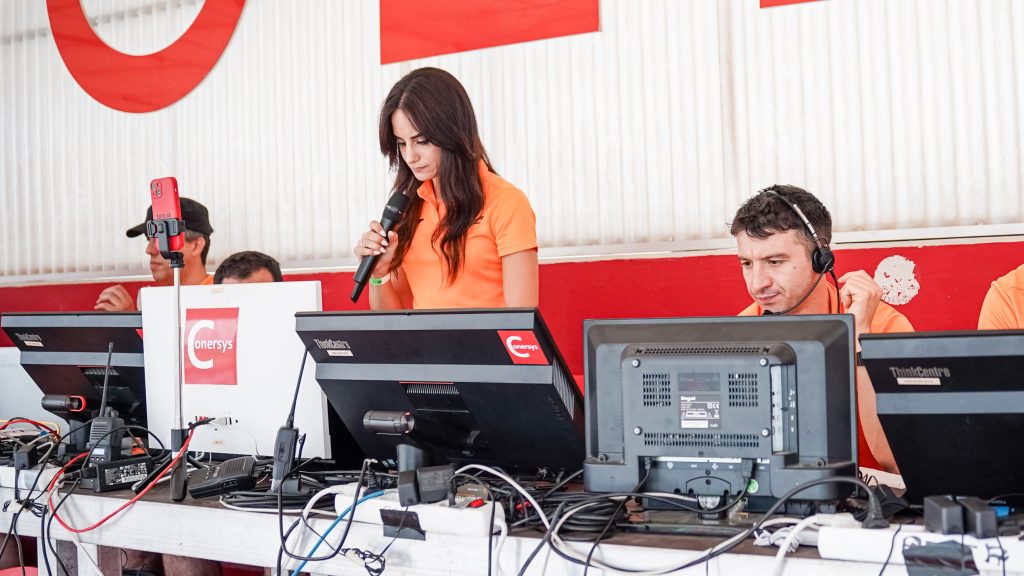
“Finally a woman here!” a spectator told Coral Aja a few days ago when she speaker He took the microphone away from his mouth for a moment while he was telling what was happening at the Spanish 10 km road athletics championship in Ibiza.
And, in fact, Aja is one of the few women who regularly act as announcers in competitions top level in Spain. A journalist and passionate about this sport, the 33-year-old Cantabrian rejects the “pioneer” label, but the truth is that she is the first woman to occupy that position in Spanish athletics. And she herself admits in an interview with RTVE that she never imagined herself in that job because “she had always seen men.”
In this case, more than a question of seeing, it is about listen. Just as feminism teaches to look with gender perspective –with the purple glasses–, as 8M approaches at RTVE.es we have put our ear to the sports venues of Spain with a kind of purple headphones to confirm that in this area of communication there is also great inequality.
For 11 days, from Thursday February 12 to Sunday February 22, 2026, at the central controls of the TVE Information Services, in Torrespaña, the complete signals of 25 competitions that took place in Spain were received, 12 of them men’s, 10 women’s and three mixed. In all the men’s cases except one there were speaker. In women, only in half. And of the 20 speakers we recorded, in 17 cases we identified the voice of men and only three of women.
To try to explain this imbalance, we turned to the doctor in Sociology Marta Blanco García, that, although he has studied discrimination against women in various aspects in sport, “he had not noticed” this particular aspect of communication. “Not because it doesn’t seem relevant to me, but because I think it is one of the many things that we already have as normalized,” he explains.
A presence that ‘fights’
“(Communication and sports) are two very sexualized and very discriminatory industries. Sport is a very masculinized scenario in which the presence of women has been fought for for a long time, but in which we detect clear differences in presence in positions of responsibility or representation beyond sports practice. So, the very fact that there is no commitment to the presence of women, in this case as announcers, has an influence because the same patterns continue to be reproduced,” analyzes the professor at the Rey Juan Carlos University.
Furthermore, Blanco García points to a double symbolic value in this issue. Indirectly, because an announcer “has the ability to give voice to what we are seeing”; and directly because with the speaker “You are putting someone who you assume knows what they are talking about, you are assuming that they are people with experience and communication skills, with a experience directly linked to those technical or control positions within sport.”
However, there is an exception that proves the rule. At least in the sample mentioned above. In the two athletics events of the period analyzed there were women speaking.
Coral Aja was one of them, of course. It has been linked to the Royal Spanish Athletics Federation as the voice of the major national competitions, on many occasions working in a duo with another announcer, usually Alberto Pozas, or also with Carlos Domingo. “The one of you It gives a touch that people greatly appreciate,” comments this communicator.
Asked if he has suffered discrimination Because she is a woman in this profession, at first she answers no. But then she admits that when they are preparing the event with the other announcer, sometimes other people in the organization address the man and not her. “I don’t know if it’s because maybe I’ve been there for less years or why,” says Aja, who says she got to this position through a mix of coincidences and having said “yes to all the opportunities” that have come her way in life.
Question of opportunities
In any case, the Coral Aja’s career is on the rise and in 2025 it narrated one of the most important athletic competitions held in Spain in recent years, the European Championship for national teams, and specifically one of the most exciting moments for the local fans, Jael Bestué’s Spanish record in the 200 m.
Jaël Bestué wins the 200 m of the European team competition with a Spanish record
“I thought the Vallehermoso stadium was falling. And to have my voice telling everyone what (the sprinter) was doing… It was sensational,” recalls the speaker of Castro Urdiales, who before each competition has to prepare the data “in detail” of the participants.
Specialization is one of Coral Aja’s strong points, but it also means that she has to make it compatible with other jobs. “If you only dedicate yourself to athletics, it is very difficult to make a living from this. If you dedicate yourself to announcing many sports, you probably can,” he comments.
But returning to the broadcast sample, there are not many opportunities for speakers: They do not occur either in men’s competitions or in the women’s categories of well-established sports. Nor in the only competition professionalized in Spain for women, the F League.
Marta Blanco, member of the Sociology of Sport Committee of the Spanish Federation of Sociology, opens the focus and talks about the context of these situations: “We have experienced many very recent circumstances in sport that have shown us that indeed the conflicts are there. The needs for change are there, but there must first be a capacity and a real interest in change so that the structure of the change itself can be woven.”
“The reality is that, on the part of the majority of institutions, there is still a lot of will to change“concludes the sociologist.