Racism remains one of the biggest challenges for world football. Under the presidency of Gianni Infantino, FIFA has implemented protocols and campaigns to combat it, but incidents continue to appear in different leagues and international competitions.
Origin of the “Vinicius Law”
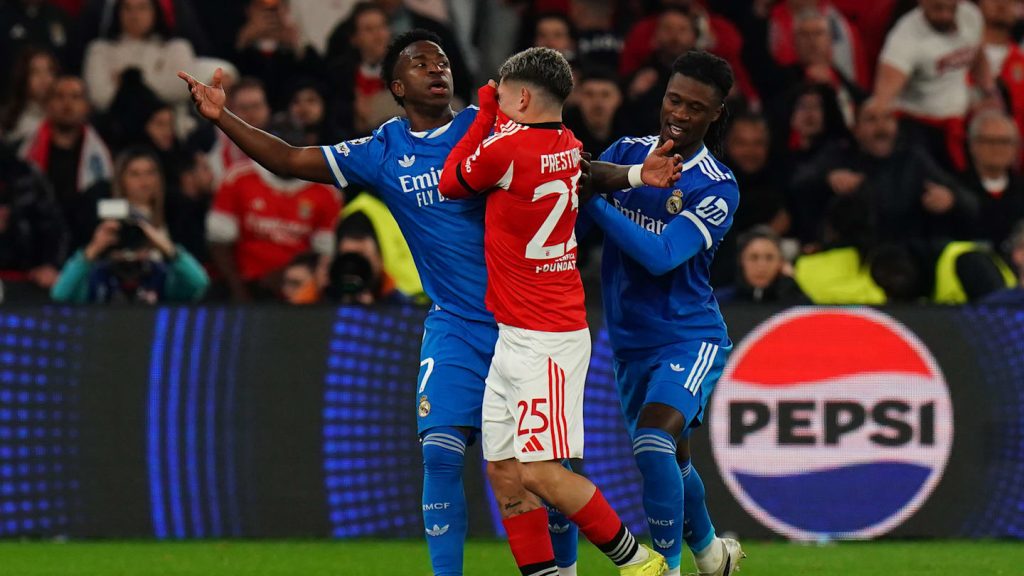
The controversy sparked after an incident in which Gianluca Prestianni, a Benfica player, allegedly uttered racial insults towards Vinicius Jr., a Real Madrid star, while covering his mouth with his shirt. UEFA applied a provisional one-match ban, and the case remains under investigation.
This fact caused FIFA and the International Football Association Board (IFAB) to take a more decisive step against discrimination on the field.
After the events, the Argentine player could not play in the second leg that was played in Spain, in which Real Madrid ended up qualifying for the round of 16 of the Champions League.

At the recent IFAB Assembly, held on February 28, it was agreed to expressly prohibit footballers from covering their mouths with shirts, hands or other objects when addressing an opponent. The measure seeks to prevent racial insults or any form of discrimination from being hidden and going unnoticed by referees and authorities.
Possible sanctions
To enforce the regulations, establishing a disciplinary mechanism within the regulations is being evaluated. One of the options being analyzed is to caution the player who commits this action with a yellow card, although the system could be adjusted in accordance with the evolution of international regulations.
A LOT OF EYE🤯❌️🔥
📰🔥 According to AS, the IFAB and FIFA are already promoting the “Vinícius Law” ⚖️, which would prohibit players from covering their mouth with their shirt or hand when speaking on the field 🗣️✋.
⚽ The measure was born after the controversy between Vinícius Júnior and Gianluca Prestianni, and they seek… pic.twitter.com/lP2yzACevv
— 365Scores (@365ScoresApp) February 28, 2026
This initiative is expected to be officially approved before the 2026 World Cup, which will be held in the United States, Mexico and Canada. With this measure, FIFA reinforces its commitment to zero tolerance for racism and any form of discrimination, remembering that football must be an inclusive space for all players and fans.